Thursday, May 15, 2014

What Remains The Same

I'm about to end the most significant chapter in my life, high school, and with that, my identity is about to change significantly. Of all the labels I've worn over the past few years, perhaps the most significant is my identity as a swimmer. I will no longer be able to define myself as someone who gets up at 5 am three days a week to fit in an hour-and-a-half practice before school. I also will no longer be able to label myself as a leader within school. I'm losing my status as a senior, as president of Project Earth, as a member of the Glenview Natural Resources, as a captain on the swim team. I'm going to be right back at the bottom in just a couple short months. 

I've grown comfortable with my environment- in the metaphysical sense, not just the steady rotation of bitter winters and blistering summers. I am used to the people I see everyday, and I love them (most of them...) for who they are and how they've affected me. 

Next year, at Northwestern, I'll still have to deal with the Chicago climate. My environment won't be physically changing, but it will be changing far more than if I and everyone I know from Glenview moved to Bora Bora. 

But despite these changes, who I am inherently will not change– not drastically at least. I will still strive to stay physically active; to remain a leader; to care for the Earth; and, most importantly, I will carry with me the experiences and memories that have shaped my development. 


Tuesday, May 13, 2014

An Inconvenient Certainty

   As of late, I've become very sure of one thing: There is no right answer–to how you live your life, to the decisions you make, to the telling of right from wrong. I feel like we are all brought up to see this distinction, that of right from wrong, good from bad, etc. And I've always prided myself that I do know that difference; that I can make the right decisions. But now I've begun to realize that good and bad paths alike can fork off of both good and bad decisions, or that one thing may be both right and wrong at the same time. 
  Such a part of my realization is simple. Of course the answers aren't always going to be black and white. I accept that; I've accepted that since kindergarten when I learned that "c"'s can sometimes be pronounced with a hard, "k" sound, or a soft, "s" sound. What I find to be an inconvenient truth is the fact that answers I always thought were simple to find are not. 
  What scares me is the amount of ways you can live your life. The infinite paths you can take to get to the same outcome, or one completely different. How do you know which way will be the right way, the good way? I suppose this is what makes life interesting and exciting. If one always knew the right way, there would be no unintentional error, no mistakes. There would still be the freedom of choice, but that choice would be more predictable. Yet I'm realizing that this also makes life scary and stressful. 
I feel like this realization of the truth changes the foundation of my childhood; the objectives ingrained in me by my parents and society that I might grow up to be a genuinely good person, have genuinely good friends, have made the so-called "right" decisions, be successful, and most importantly, be happy. I always took this outcome for granted, because, as I said above, I pride myself on knowing right from wrong. Every day, though, I see myself make choice after choice, and I travel along one of the countless paths through the maze of diverging branches on this gigantic tree. I'll have to accept this path, but at the same time realize that I can travel in a different direction whenever I want, even if I'll only know my moral location when I finally emerge from the thicket.

Wednesday, March 19, 2014

The Relationship Between High Schools and Municipalities

Today I am participating in the Chicago Wilderness Congress 2014 convention as a roundtable presenter. The presentation I am doing with another member of the Natural Resources Commission is about incorporating local high schools into municipal planning and events.

Project Earth has had a long-standing relationship with the NRC, due mainly because of the student commissioner requirement written into the NRC’s forming documents. Our faculty sponsor also deserves a lot of credit for maintaining the relationship, as the student commissioner will come and go but he remains a constant.


The relationship between Project Earth and the NRC began with Project Earth providing a volunteer base for the Village's many clean-up days/plantings, but has grown from there. PE and the NRC now jointly maintain a detention basin on Pfingston Rd, plant a tree on GBS grounds for Arbor Day. 

Friday, February 28, 2014

The Nature of Sparsity in Shakespeare


One thing becomes abundantly clear when reading any of Shakespeare's works: his plays lack stage direction and scenery, despite vividly worked-out plots and advanced characterization. Why did the environment of his plays not reflect this same complexity?

I immediately jump to answer that question with "It was another clue to Shakespeare's brilliance," meaning that he intentionally left his plays as universal as possible. Today, there exist so many varying interpretations of Shakespeare's works. From traditional to pastiche, the scenery of these countless versions differ so greatly that there is bound to be an interpretation that appeals to anyone.

The vague language pertaining to the setting was brilliant, but now I believe that brilliance to be unintentionally so. Elizabethan theatre traditionally did not place an emphasis on scenery. The expenses of putting on a play were instead diverted to fine materials for costumes. Shakespeare, it seems, was merely following the norm of his time. 

But nevertheless, the ambiguity concerning how Shakespeare's environments should be constructed and detailed has been paramount in the development of different interpretations. My English class just finished reading and studying Hamlet. An integral part of our study was watching very different film renditions of the play. We watched David Tennant and Patrick Stewart in a modern-day, pastiche Hamlet. We watched traditional versions featuring Kenneth Branagh and Mel Gibson as Hamlet. And we watched a very strange modern-day version with Ethan Hawke and and Julia Stiles. 

Ethan Hawke and Julia Stiles
Kenneth Branagh
David Tennant and Patrick Stewart
Mel Gibson


The settings and scenery in each of these versions varied immensely, with different aspects of each being surprisingly effective. The blue, grey, and black color-scheme of the David Tennant version gave a serious, and rather grave feeling to the play. The traditional settings in both the Branagh and Gibson versions gave a more authentic feeling to the play. And the absurd, 90's filter put on the Hawke/Stiles version made the play hard to take seriously.

The environment a story is set in is inherently important to even the most universal of plots, as becomes abundantly clear when watching very different versions of the same story of Hamlet. It is easy, however, to take for granted that the environment and the plot are locked to one another. Environments can be changed, thus changing what one takes away from the same story. Once a version is created, though, the setting and the plot feed off of one another in what is hopefully a very beneficial relationship. 

Monday, February 10, 2014

The Olympic Environmental Dilemma

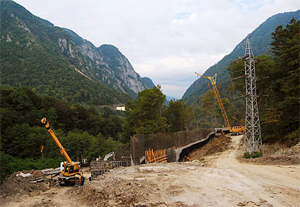
There’s been a lot of talk about the despicable conditions in Sochi, Russia. Olympic Village apartments and hotel rooms around the town are barely, if at all ready to be lived in, streets remain unpaved, and the piping systems deliver water that only comes in the yellow or brown variety. The Twitter account @SochiProblems now has over 100,000 more followers than the official @Sochi2014. The world has been quick to point out the flaws in these Winter Olympic Games and their construction, but not much emphasis has been placed upon how the construction is devastatingly flawed on a much deeper level, the environmental level.

Though Sochi National Park is a protected UNESCO World Heritage Site, the construction of the Olympic venue has cost the park approximately 8,750 acres. Contractors have planted 1.5 million trees and built an Ornithological Park in compensation for what has been destroyed, but the destruction of land and movement of native species, have come at a price that cannot be repaid.

Although the media hasn’t been focusing on the environmental costs that have come with the arrival of the Sochi Olympics, why have I heard even less about the environmental impacts of previous Olympics? Perhaps because the past two summer Olympics have been held in cities, or perhaps because the last winter Olympics, held in Vancouver, marked a significant step in making the mega-event more eco-friendly because of the Olympic Games Impact (OGI) study.

But yet the very fact of a global event such as the Olympics held every other year is going to affect any local environment enormously for a couple-year period, and then leave a void once that Olympic Village is retired. For all the camaraderie and unity that stems from the Olympics, t seems like an enormously wasteful tradition. But yet we continue this practices because we enjoy the luxuries we've made for ourselves in life. We enjoy our luxurious and extraordinary Olympic venues. The spectacle is far too alluring to drastically change how the Olympics are run, but hopefully the disastrous effects of Sochi will serve as a warning, an example of how exactly not to build an Olympic venue.


Tuesday, January 14, 2014

Nature in Iran

Iran is riddled with environmental issues, most critically the desertification of two-thirds of the country's land area, and choking levels of air pollution.  Issues that have arisen out of lax environmental policies are now in danger of doing serious damage on the Iranian economy. 

The country's water resources are dwindling because of dependence on groundwater as the water source. Pumping groundwater is cheap for citizens because of government subsidies, and most of the rivers in Iran are unusable as a renewable energy supply. The water shortage may soon cause drastic problems for the agricultural sector, which is the major economic sector in Iran. A decrease in agricultural yields and an increasing population are a recipe for economic disaster in Iran. 

Amongst the world's most polluted cities as ranked by the World Health Organization, three of the top six are in Iran. Ahwaz, the capital of the Khuzestan Province, where most of Iran's oil is produced, is currently ranked at number one. 

But in the midst of so much publicity on Iran's nuclear program, the serious domestic environmental issues are seemingly forgotten. The Green Party of Iran is hoping to change this. In opposition of the current regime's manufacturing of WMDs, the Green Party also hopes to bring focus to Iran's environmental policies, and further expose how governmental sanctions have led the country to the brink of an arid, resource-dependent future. 


The lack of coverage on the dry environmental future that Iran is currently confronted with is appalling. The northern part of Iran remains hydrated and teeming with wildlife, especially in Golestan National Park. But if these issues are not addressed, even such a dense forest is in danger of drying up.